


Alfred Hrdlicka
I can’t think of a thing, but I notice some things
27/02/2003 - 25/03/2003
Galerie Ernst Hilger
A-1010 Wien, Dorotheergasse 5
T: +43-1-512 53 15
F: +43-1-513 91 26
hilger@hilger.at
www.hilger.at
Alfred
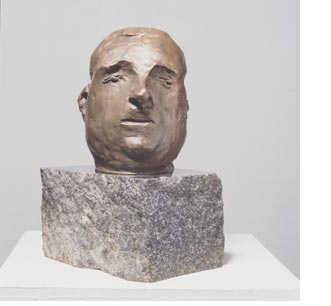
Hrdlicka, Hommage à Qualtinger, 1986, bronze, 17 x 14 x 19
cm
Vernissage: 27 February, 19.00 hrs. (until 25 March)
On the occasion of Alfred Hrdlicka’s 75th birthday,GALERIE ERNST HILGER is showing selected works on the subject of portrait art.
A number of small bronzes from different cycles, such as “Schubert” or
“Wagner”, as well as large-scale sculptures, such as the portrait of “Giordano Bruno”, are shown. Moreover, the exhibition provides a comprehensive presentation of his graphic works, such as etchings (“Pasolini Cycle”) or lithographs, as well as medium-sized ink and
crayon
drawings – especially from the seventies. These works are largely
called
studies or pictures accompanying his cycles which in themselves, however,
are of a high artistic standard.
At the same time, the Willy-Brandt-Haus Berlin is staging an exhibition
“Alfred Hrdlicka – Zum 75. Geburtstag” ( Alfred Hrdlicka
– On his 75th
Birthday).
A catalogue and book is published in connection with the exhibition.
Below are excerpts from the catalogue text by Paul Kruntorad: “Dear
Alfred, ….”
” … ‘All art comes from flesh’. In a conversation back
in 1994 you put it
that way and said, ‘that without a picture of man, art is actually nothing
but decoration, or entertainment …. Art that does not deal
directly with human problems, with politics, with religion, with psychiatry – to mention just a few areas that I have dealt with – is not art.’ It would come in handy to call you a “critical realist”, and it would not even be that wrong. After all, the criticism, exaggerated into polemics, can hardly
be overlooked. In the long history of European art, ideas were the topics of art, the program for the pictures was conditioned by ideologies. And
that’s what the big graphic cycles are about – ‘Randolectil’ being the confrontation with psychiatry and its allegation that there is such a thing as ‘normal’ human behavior, ‘Roll over Mondrian’ being a satire on abstract art as a party game. Time and again these are secularized versions of the medieval dance of death, demystifications of myths. I
think that when you look, you do not focus on the realities that correspond to a convention on viewing, but you look behind the curtain
that veils society’s conventions, you look inside, at what dominates the social structures – sexuality and violence. Your sculptures – head and
torso, portrait bust and figure, carved out of stone in ‘taille directe’
–
always also refer to the work involved, they are definitely anti-classicistic,” …. “Not the sculptures as such as realistic,
but your
manner of seeing things is so, in the sense that Freud and Ernst Mach were realists.”
…… “Let me wish you many happy returns – Your Paul
Kruntorad”
Short Biography:
1928 – born in Vienna
1945 to 1957 – attended the Academy of Fine Arts (Güthersloh,
Wotruba)
1960 – first exhibition at Zedlitzhalle, Vienna
1964 – Biennale Venice
Numerous professorships at national and international art academies
A great many exhibitions in Austria and abroad (detailed information
available on request)
For images and text material please visit www.hilger.at

