


Today, of course, she would have gone to university, found an outlet for her intelligence, disciplined her seething imagination and probably ended rich and successful.
—P.D. James1
The most trivial pedagogical approaches to literacy are based on the recognition and execution of signs without any consideration for the communication processes that generate those signs. In learning how to write, the first step was always to fill pages with letters. In art, it was to fill pages with horizontal and vertical parallel lines, and even today some children are still doing color by numbers. Academic teaching becomes even more dangerous in art than in literacy. In art, exercises in building academic skills are designed for instant gratification and efficient grading, but also introduce aesthetic dogmas.
Attempts to faithfully copy an external image are undertaken without any examination of the ideological and philosophical implications. Among these implications are: a belief that the perceived image of reality actually is reality; that our senses act as recorders rather than translators; that rendering is art and not just a way of processing information; that reality is an externally created order; that beauty is an external value. Academic realism could be said to attempt restrictive transliteration rather than translation. A discussion of any one of these issues would lead to more interesting and productive exercises than the dull copying of still lifes or nude models2 On the other hand, many more contemporary formalist assignments are equally restrictive. They favor appearance over deeper problem-solving and, ultimately, are more concerned with packaging theories (for instance, functionalist aesthetics) than creation.
In all the traditional approaches to pedagogy, both in art and in literacy, the possibility of perceiving the transitional nature of the space produced by text or image—the common space for author and receptor—is completely lost. The emphasis is on producing communication vessels that are static and consumable objects, for which the sign has to be well executed. In this kind of art, execution has to reach the point of desirability, which in turn defines success.


Teaching and instruction are generally used as synonyms, something that reflects an implicit pedagogical ideology. The word instruction is a homonym: it refers to the instructions given on how to perform a task as well as to the induction of the learner into a world ruled by instructions. Pedagogies of instruction are academic and vertical. They are based on the instructor’s monologue and focus on attaining perfection through repetition. Traditionally, listening and being “instructed” constitute the first stage the student has to go through.
Co-learning and mentoring establish a horizontal relation among the participants, based on dialogue rather than on the delivery of monologues; if and when this happens in a traditional setting, it is reserved for advanced students. The presumption is that dialogue has to be earned, as if respect and collegiality were not intrinsic to pedagogy but gifts for the deserving. In this situation the learner is not a recipient, but somebody participating in a process of construction. Here construction, as opposed to instruction, addresses the building of both a discourse and the ability to deliver it.3 Only at this point are expression and communication accepted. The effect of this delay is that the discourse, once achieved, takes the shape of a new monologue or set of instructions, and the system is perpetuated.
The separation of instruction from construction, as well as the primacy of the former, relegate expression and communication to, respectively, second and third place in art, and third and second place in writing. In each case, the categories of expression and communication are not necessarily integrated. The artist often expresses without communicating, while a written manual may communicate without expression. The difference in orderings with respect to art and to literacy always reflects certain cultural expectations. After and in spite of the initial instructional or craft period, art is presumed to express individuality. So expression is favored over communication. In literacy the expectation is social adeptness, so communication precedes expression—Literacy is left to functionality and collectivity, while art remains individual and implicitly elitist.


Orality
Oral societies seem to prefer an art that is static because it confirms and stabilizes collective cultural traditions. A great deal of energy is spent on maintaining communication with relatively little space for expression. Works in the oral tradition (exemplified by Homer’s epics) only maintained their connection with the original over time due to cadence and rhythms of breathing that limited the risk of deviation.4 As a means of expression closer to text than to music, today’s hip-hop offers an unexpected return to orality.
By transferring collective memories and individual ideas into documents, literate cultures ensure that collective memories stay or become a common good. They achieve easy portability and circulation. In oral societies one wears the collective knowledge. In societies with documented knowledge, the individual refers to knowledge without having to wear or otherwise lug it around.5 He can move about unhampered by collective dress. This increases the freedom to inquire and to express oneself with regard to the duties of representing collective knowledge. The stage for this is a marketplace that, in trying to follow these individual escapades, becomes increasingly rarefied and alien to any grassroots culture. One might speculate that in certain ways high literacy leads to fewer people understanding good art than bad art.
The word literacy tries to accommodate many more issues than it has room for. There is the literacy of children entering adult society, the problem of functional illiteracy among adults, and the access from one language to another. What is common to all of these is that the language chosen to define literacy acquires a status of hegemony. Functionality then is to be achieved within what can be defined as a hegemonic language. Badly implemented literacy education can displace other existing functional codes, both in terms of orality and in what would then be “non-hegemonic” languages. Sometimes this non-hegemonic language is just a communication code (from a baby’s cry onward); sometimes it is a dialect or vernacular, sometimes a foreign language (in which there might be full illiteracy or just an inability to read the new, hegemonic language).
In the introduction to The Making of Literate Societies, David Olson and Nancy Torrance point out that when a new written code (language) forcefully enters a culture that has a pre-existing code (written or oral), this immediately generates illiteracy.6 While the old code is devalued, the new one will not be fully acquired. Literacy therefore is simultaneously a tool of disempowerment and empowerment, one that creates a much richer and fragile situation than pedagogical methodologies manage to fully address. Literacy is presumed to allow us entrance into modern society and ensure survival, and the emphasis of teaching is on this aspect. This explains the interest of the state in offering compulsory and free primary schooling in a majority of countries. If the purpose were to empower and promote creative freedom, not only would different education systems be used, but everybody would also have access to free education up through a terminal degree.
Only later, after state interests are absorbed (or a critical distance is developed against them), may language become an instrument for freedom. Individual interests may only be satisfied once the expressive level is reached. Already in 1492 Antonio de Nebrija observed in his book about Castilian grammar: “Language was always a partner of the Empire.”7 Nebrija was very positive about this: the hegemonic language reduces the other languages to a secondary role or attempts to eliminate them. Spain eliminated Nahuatl in Mexico as well as another estimated 400 indigenous languages in Latin America. And when “first languages” disappear, so does the knowledge that initially demanded and generated those languages.8 In certain ways the same happens with the de-infantilization of children’s drawings, the loss of naïveté (or its stylistic freezing) in naïve art, or with the translation of tribal art into airport trinkets. In both the pre-literate stage and the other-literate stage the original codes used for communication are neglected, devalued, or condemned, rather than built upon. For some forms of education, colonization may therefore be more than just metaphor. Insofar as the new code becomes the standard, class differences become sharper and new separations are created thanks to the profits brought about by the assimilation to the new code and protocols.9
The concept of “multiliteracies” which emerged during the 1990s tried to address many of these issues.10 Recognizing that there is no valid “canonic English” and responding to ideas prompted by globalization, multiculturalism, and the changes in capitalism, “The New London Group” developed a platform to change literacy pedagogies to both reflect and promote social change. Among the group’s more radical goals is the redefinition of the teacher as a “designer of teaching processes and environments,” and the extension of the notion of literacy from language to the broader concept of “semiotic activities,” in which organized meaning is analyzed in non-verbal activities like play. Looking for a language to encompass and help organize these more general activities, a differentiation emerged between language, dialect, and voice. Language here has the hegemonic role, while dialect may preserve some of the original codes reserved for vernacular communication, and voice gives power to the expression of the individual.
These distinctions also seem to apply to art, although with a difference in the respective emphases. In literacy, language—hegemonic language—is the medium to be mastered. In art, the hegemonic language is the reference against which one may deviate a little to show originality. In literacy and art, dialect or vernacular tends to be looked down upon. In art, clearly, it is the voice or personal expression that eventually is extolled by the market, as long it operates within the hegemonic language.
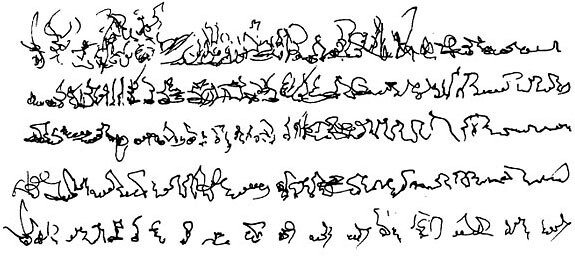

Voice / Personal Spelling
Typically, when discussing illiteracy, people make the assumption that the illiterate subject is “ignorant” because he or she doesn’t know how to translate oral code into a visual sign system. Accordingly, teaching someone how to do that is considered instruction, and the measure of success is the degree to which the product is free from deviations from the canon. Spelling rules, for example, are absolute; deviations are not only unlawful, but also seen as a badge of ignorance. Free play with spelling, made in the interests of expression, are only tolerated at a more advanced stage of education for those who qualify for the more rarified creative literature.
While there is a traditional neglect of voice and dialect in literacy, it is slowly being accepted that there should be a respect for the vernacular basis, and that there is a need to raise awareness and suggest an eventual contact with meanings.11 Some educators even favor the development of personal forms of spelling (an opening for the “voice”) preceding the learning of the canonic one, so as to facilitate the contact of the written code with experienced reality.12 Controversial at the early stages of literacy, the later use of vernacular misspellings and non-hegemonic wording can enhance both expression and communication. A prime example is Junot Diaz’s The Brief Wondrous Life of Oscar Wao (2007), in which the vernacular Spanglish is so strong that the English and Spanish versions of the book become very similar.
The use of personal spelling in art would have the learner first sketch an idea in any personal idiosyncratic manner, without considering how it might be understood by other people. This stage is therefore only concerned with the development of mnemonic devices: images that are recognizable and decodable by the author, with greater precision possible at a later stage. Canonic spelling would appear in a second stage. The drawing then becomes the equivalent of a technical drawing delivered to a builder by the architect. In writing, the parallel is a shopping list for somebody else, or, in its most sophisticated version, the entire legal code of a country. The claim to art can only be made once expression or speculation becomes the grounds for communication. Only then can what would have been a mistake by canonic standards be interpreted as poetic license or as a creative device. But without sufficient power of persuasion, the same gesture would remain a transgression or a sign of ignorance.
The Placement of Order / The Arbitrary Order
Teaching coding and decoding solely as craft seriously impoverishes communication. A caricature of such an approach has led to pseudo-rational yet aberrational constructions like Basic English, an attempt by English linguist Charles Kay Ogden during the 1920s to reduce English to 850 words in order to help establish it as the international language.13 The same attitude in art has tried to create a good draughtsman by reducing the human figure to ellipses and rectangles.
More enlightened theorists of pedagogy suggest that creativity should share the early stage of education with literacy rather than follow it. But in presenting the recommendation in this way, they are reinforcing a problematic assumption—that alphabetization might be parallel, but distinct and different from creativity. However, to separate alphabetization from creativity in the first place—even while making them synchronic—accepts an unwarranted and misleading separation between the two.
Like “order” and “instruction,” the word “alphabetization” is also a homonym, but this one refers to the other two: the instruction in literacy and the order in alphabetical sequence. Normally we keep these two meanings sharply separate. But it could help to advance more integrative pedagogy if we actually focused on them simultaneously, so that we might see the connection between taxonomies in education and the power in making order.
Both writing and doing art deal with making order. The signs used in writing originate in arbitrary decisions, but the connection with arbitrariness is lost when convention takes over. The convention of long usage kills even the memory of the initial arbitrariness of the signs and gives them an objective and seemingly inevitable presence. Order is thereby preserved. In art, it would seem the opposite: the signs used are not “arbitrary” in origin, in that they mean to be representative, but the order they serve is supposed to be arbitrary (“original”).14 In both cases, what is important is order—whether confirming an old order or inventing a new one.
Given the importance of making order, it would seem that a sane pedagogical approach would use this order as a fulcrum. In such pedagogy, the first step would be the perception of a need to establish or register an order to be communicated, where the second step would be to explore the origin of that need, as well as the relevance of power relations. The third step would be to search for the most effective code to transmit and register the order to be communicated. The fourth would be the mastery of that code to achieve effective communication.
This sequence, which is based on common sense, is not sufficient to eradicate authoritarianism in education. Authoritarianism is so deeply rooted in formal education that even “progressive” reform committed to more “permissive” pedagogy fails to tackle the key issues of who controls existing systems of order and their protocols, as well as the limits placed by them on thought and imagination.
Putting everything together, it would seem reasonable to start the learner on a quest to establish his or her own need for communication by exploring questions such as: What should be communicated, why, and in what system of order is that need located? Does it originate in the self, and, as a primary goal, seek its satisfaction? Is it of social use (to give pleasure, issue a warning, or provide enlightenment)? To whom is it communicated? What form of code does the idea to be communicated assume? What code should be used or created to translate the original idea? How will that code accommodate the message one has in mind? How will that communication be understood and be most persuasive?
It is ironic that these questions, in this sequence, would put teacher, illiterate student, artist, and fellow citizen all in the same position. By dispensing with hierarchies and pursuing the search, creation, and challenge of orders within which needs can be identified and decided upon, incentives for communication become the basis for constant learning and articulation. While this will not necessarily make everybody creative, at least it won’t prevent the learner from being creative.
PD James, The Murder Room (London: Penguin, 2003), 12.
It is interesting that life drawing came from the belief that the human figure was the embodiment of beauty, and that then the beauty part was soon forgotten.
Opposing “construction” to “instruction” only indirectly refers to constructivist pedagogies based on the theories of John Dewey, Lev Vygotsky, and Jean Piaget. Here it refers only to the placement of power in the teaching process.
Ivan Illich and Barry Sanders, The Alphabetization of the Popular Mind (San Diego: North Point Press, 1988), 6.
It is worth pointing out that, historically, the passage from oral to written culture in the West was much slower and complex than literacy education would imply. Dictation was one of the transition stages. People in power did not necessarily know how to write and would dictate to scribes. When documents were copied, it was not a given that the copyist would know how to read, since it was believed that a non-reader what make more faithful copies than a reader who understood the text (Illich and Sanders, 45). The original owner of the second-hand book by Illich and Sanders from which I took this information made some interesting notes in the margin of the page. He reminded me that today many texts are sent to Asian countries for keying into a computer, the originals often being in English and copied by non-English speakers (note on margin by Michael Comveau, ca. 1992, on page 45).
The Making of Literate Societies, ed. David R. Olson and Nancy Torrance (Oxford: Blackwell Publishers Ltd, 2001), 6.
Fernando Báez, A Universal History of the Destruction of Books (New York: Atlas & Co., 2008), 126. In a petition to Queen Isabel, Nebrija wrote: “Soon Your Majesty will have placed her yoke upon many barbarians who speak outlandish tongues. By this, your victory, these people shall stand in a new need; the need for the laws the victor owes to the vanquished, and the need for the language we shall bring with us” (cited in Illich and Sanders, 68–69).
See K. David Harrison, When Languages Die: The Extinction of the World’s Languages and the Erosion of Human Knowledge (New York: Oxford University Press, 2007).
After the independence of Uganda, Milton Obote analyzed the adoption of English as the official language, aware that there was no alternative: “The Ugandan National Assembly should be a place where Uganda problems are discussed by those best able to discuss them, and in our situation it would appear that those best able to discuss our problems are those who speak English. This is a reasoning that cannot be defended anywhere; there is no alternative at the present moment.” Kwesi K. Prah, “The Challenge of African Development,” in Olson and Torrance, 130–131.
See The New London Group, “A Pedagogy of Multiliteracies: Designing Social Futures,” Harvard Educational Review 66, no. 1 (Spring 1996).
Olson and Torrance, 10.
Utz Maas in “Literacy in Germany” opposes this view, pointing out that written linguistic rules are too different for this first form of codification to be useful in the second. In Olson and Torrance, 94–95.
Charles K. Ogden, Basic English: A General Introduction with Rules and Grammar (London: Paul Treber, 1930), available at href=”http://ogden.basic-english.org/be1.html”>→. In the introduction Ogden writes: “If it be asked: why 500 words, why 850 words, why 1,000 words; why not 750 or 1,100, or even 1,234, since there is no magic in numbers?—the answer is that Basic is severely practical. Inasmuch as there are limits set (a) by the number of words which can be legibly printed on the back of a single sheet of note paper, (b) by the capacity of humans to assimilate symbols in thirty to fifty hours, (c) by the minimum first stage that is complete in itself, certain definite frames are indicated to which the linguistic material of a universal language must endeavor to adapt itself.”
“Representative” means that the signs represent some part of art’s conventional system, of which figuration is one of multiple choices.