


A Grain of Dust A Drop of Water
10 September – 13 November 2004
GWANGJU BIENNALE 2004
Press Opening : 8 – 9 September 2004
Mon – Fri 9:00 to 18:00 Sat & Sun 9:00 – 17:00
San 149-2 Yongbong-dong Buk-gu
Gwangju 500-070 Korea
Phone +82 62 608 4260
Fax +82 62 608 4269
biennale [at] gb.or.kr
www.gb.or.kr
General Artistic Director: Yongwoo Lee Artistic Director: Kerry Brougher, Suk-won Chang Assistant Curators: Milena Kalinovska, Chika Okeke, Roberto Pinto, Won-il Rhee Sites Curators: Sunghoon Lee, Chankuk Park, Heeseung Jung, Dongjo Chang
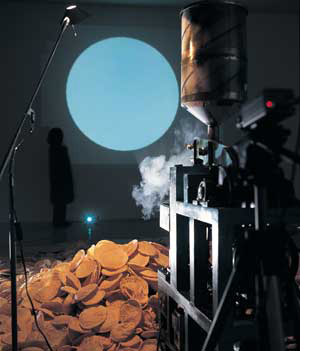
Kyoung-ho LEE, Moonlight Sonata, 2002.
The title “A Grain of Dust A Drop of Water” reflects the concept and the strategy of the Biennale. Dust and Water are vital natural phenomena, which can be understood as ecological orders describing the cycle of creation and extinction. The title also implies the idea that the Gwangju Biennale 2004 functions to enhance discussions on fragmented viewpoints and discourses existing in visual culture and to embrace multiple aesthetic definitions.
Keywords of Gwangju Biennale 2004
The Viewer-Participants
The Intention
It’s unhealthy, when it comes to balancing art production and consumption, to continue forever to put the spectator in the position of passively appreciating art. The evaluation and aesthetic values of art are not the private hunting grounds of experts and professionals. The goal of artistic production is to be actively consumed by the spectator or, rather, to incite the participation of the spectator. It’s an important decision, then, and an extreme experiment of great value for the 2004 Gwangju Biennale to have the spectator become the pivotal player in the organization of its exhibition and, thus, to create a bold opening in the customary framework built principally around the professional. The 2004 Gwangju Biennale deconstructs the hierarchical view that situates the spectator on the level of passive or, optimally, educated appreciator and, by inviting him or her to participate as the primary producer of the exhibition, tries to present exhibition culture from different and new perspectives.
The Production of Culture and a Redefinition of Consumption
To establish the system of the viewer-participant, the Gwangju Biennale created a task force team to conduct research into the spectator. Based on its findings, the task force selected 60 viewer-participants from 42 different countries and arranged them into three categories: general spectators, professional producers of culture, and cultural activists. Among the general spectators there is a farmer, a skilled laborer, an office worker, a homemaker, a student, a soldier, and so on. Among the professional producers of culture, but excluding visual artists, there are viewer-participants from the human sciences, humanities, and sciences. And among the cultural activists there are those whose jobs are to alert us and react to some of the most important problems of our times.
Beginning with a workshop held in Gwangju from the 12th to the 14th of January, the viewer-participants have, for the past six months, proposed the direction and organization of the exhibition in discussions with their artist-partners. They have also, in their participation in the creation of the artworks, fulfilled the aesthetic expectations and reached the aesthetic consciousness of spectators of differing cultural backgrounds. As for the artists, instead of defending their historical creative independence, they have also become participants in a complex experimental process of creating art through dialogue with the viewer-participants. The viewer-participant system has produced three types of outcomes: 1) harmonious collaborations between the artist producer and the consumer; 2) essentially formal, tentative participations; and 3) struggles, including separations and reconciliations through active discussions and other plot twists.
The Biennale has stood by as a possible mediator, ready to help the duos in their collaboration, but it has never participated actively. The Gwangju Biennale has tried to underline possible collaborative models, to ask out loud whether a fruitful collaboration can happen between artistic producer and consumer or whether there can be success through dialogue. It has also tried to suggest that there are unlimited possibilities for art to become the means for social networking.
Theme Exhibition
The Theme Exhibition communicates the theme A Grain of Dust A Drop of Water in different ways in different galleries. This exhibition is unusual in that outside visitors will also play a role in its creation along with the participating artists. At the end of the series of galleries, visitors will come to a space called “The Club,” a multi-cultural area for sculpture, videos, performances, and seminars.
Gallery 1 (Dust)
Gallery 1 conceptualizes “A Grain of Dust” by reviewing and reinterpreting cultural phenomena of modern society. Gallery 2 (Water)
Gallery 2 captures a spectrum of cultural and ecological phenomena and provides a visual space of “A Drop of Water.” Galleries 3 & 4 (Dust + Water)
Galleries 3 & 4 explain the creation of aesthetic values and the restoration of order in nature through the combination of dust and water. Gallery 5 (The Club)
Gallery 5 is a space for exhibitions, video works, and performances with visitors participating.
The Sites
Amusing Footsteps
Venue: The Courtyard of the Biennale Hall
Curator: Sunghoon Lee
Participants: 8 artists from around the world Korea Express
Venue: Education and PR Hall in Joongoe Park
Curator: Sukwon Chang
Participants: 30 artists from Korea And Others
Venue: May 18 Liberty Park
Curator: Chankuk Park , Heeseung Jung
Participants: 36 artists (teams) from Korea Biennale EcoMetro
Venue: Gwangju Subway and Geumnamno 4-ga Station
Curator: Dongjo Chang
Participants: 29 artists (teams) from around the world
Press enquiries:
Inhee Jung, TEL 82 62 608 4260 FAX 82 62 608 4269, press@gb.or.kr General enquiries:
Taeyoung Cho, TEL 82 62 608 4264 FAX 82 62 608 4269, biennale@gb.or.kr www.gb.or.kr
San 149-2, Yongbong-dong, Buk-gu, Gwangju 500-070, Republic of Korea