David Claerbout
Architecture of Narrative
May 21–September 6, 2011
San Francisco Museum of Modern Art
151 Third Street
San Francisco, CA 94103-3107
sfmoma.org
Claerbout’s “architecture of narrative” is based on his meticulous work with digital photography and video to explore temporality and the compression and suspension of a moment from a variety of perspectives. He manipulates cinematic time, often depicting a single moment analyzed from multiple camera angles, shifting attention between the narrative scene in the foreground and the underlying social context of the architectural background.
The American Room (2009–10) is Claerbout’s most technically ambitious work to date. In the piece, a group of people are seated at a musical recital for an American diplomat in an intimate, formal setting. The concert, however, is halted in time, with the singer forever about to sing as the camera slowly pans around the scene, examining the audience from different vantage points. While the scene appears to take place in one room, each audience member was individually filmed against a blue screen and then painstakingly composited to form the assembled group. This method allowed for infinite camera movement through a three-dimensional composite space. Music figures prominently in the piece as well, with sound travelling spatially to reflect the position of the camera in the digitally constructed environment, further establishing cohesion between the composited parts while gradually allowing for a progressive understanding of the politically charged context.
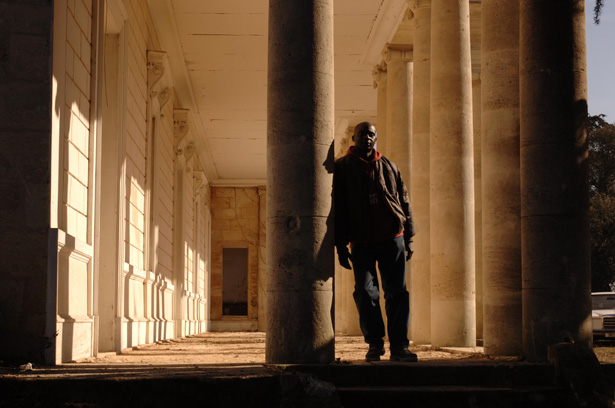
In another work analyzing cinematic conventions, Claerbout’s White House from 2005 is an approximately 13-hour video projection made from 73 almost-identical, individually filmed short scenes of a dramatic fight between two men amidst an abandoned colonial-era building. Each take grows progressively darker as the sun rises and falls both in the video and in the world outside of the museum where it is shown; the work is timed to the opening hours of the museum. With the long duration of the passing from sunrise to sunset, Claerbout brings attention to how our gaze turns from the narrative—a violent confrontation between two French-speaking African men—to the details of the film set and the permanence of the landscape.
Also featured are Sections of a Happy Moment (2007) and Kindergarten Antonio Sant’Elia 1932 (1998), both built from photographic images of children’s play. Organized by Rudolf Frieling, SFMOMA curator of media arts, the exhibition is on view at SFMOMA through September 6, 2011. Read more here.
OPENING THIS FALL AT SFMOMA
Richard Serra Drawing: A Retrospective
October 15, 2011–January 16, 2012
Sharon Lockhart: Lunch Break
October 15, 2011–January 16, 2012
Francesca Woodman
November 05, 2011–February 20, 2012
The Air We Breathe
November 05, 2011–February 20, 2012
Jim Campbell: Exploded View
November 05, 2011–September 25, 2012
For more information contact:
Peter Denny, 415.357.4170, pdenny@sfmoma.org
Robyn Wise, 415.357.4172, rwise@sfmoma.org
*Image above:
Rennie Collection, Vancouver.
© 2011 David Claerbout.